
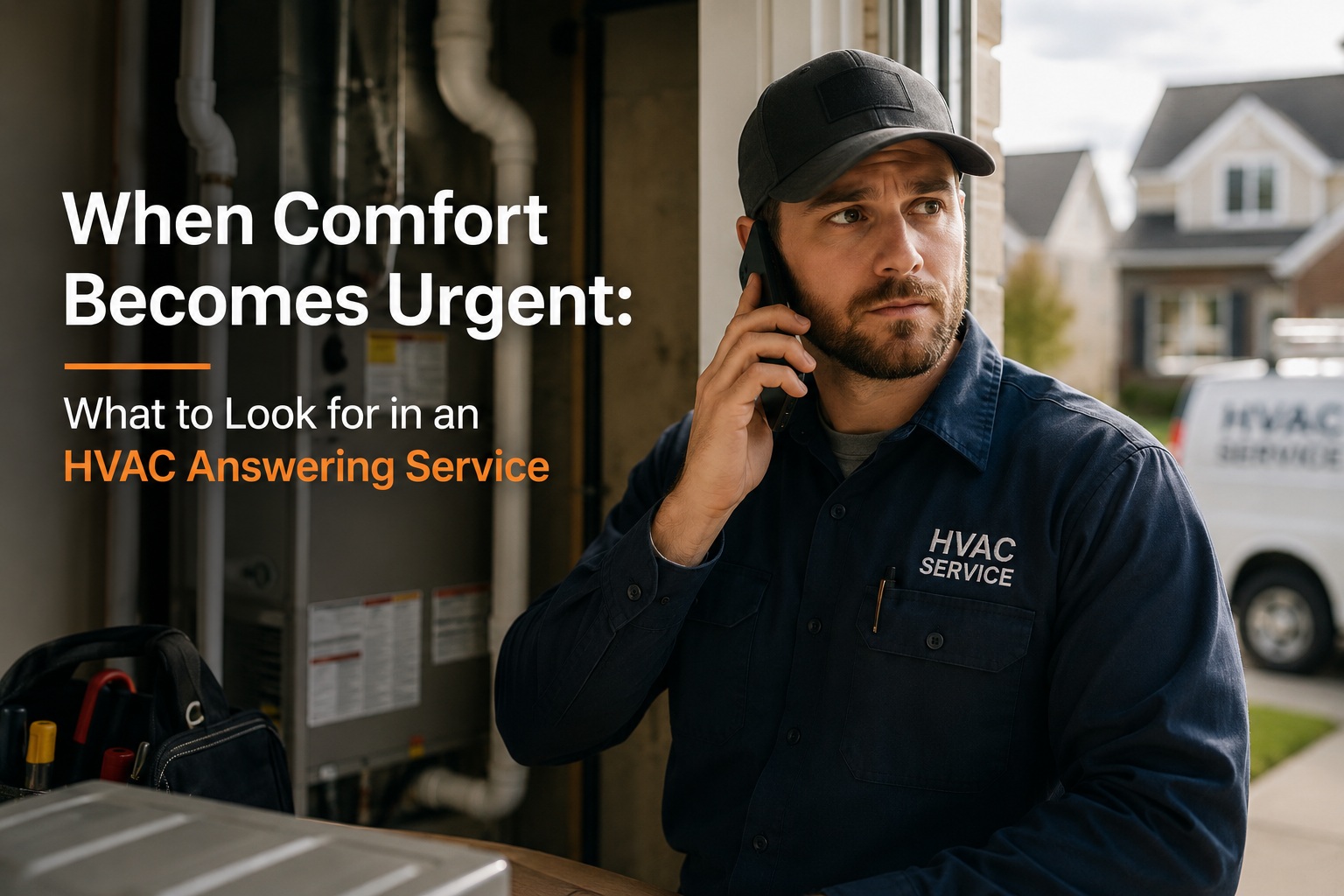

If you work in HVAC, you already know that “no heat” rarely tells the whole story.
It might mean a family waking up to a house that’s getting colder by the hour.
An elderly homeowner wondering how long they can safely wait.
A business owner watching the temperature change while customers are still walking through the door.
Or it might simply be someone saying, “Something isn’t right,” because they don’t know enough about their system to explain what they’re experiencing.
You’ve taken those calls.
And behind the service request, the dispatch information and the equipment problem is something much more human: someone has a problem, and they’ve decided to trust your company with it.
That matters not only when your technician arrives, but from the moment the phone rings. So when you trust an HVAC answering service to take that call on your behalf, you’re not simply outsourcing a task.
You’re handing them the first few minutes of a customer relationship you’ve spent years building.
Understanding: Before Someone Can Speak for You, They Need to Listen to You
No two HVAC companies operate exactly the same way. What qualifies as an after-hours emergency for one company may be handled differently by another. The information one technician wants before returning a call may be different from what another team needs. Service areas, customer types, equipment, staffing and escalation procedures all shape how a company responds.
Those differences aren’t problems an answering service needs to solve. They’re things it needs to understand.
You already know how you want your business to operate. You know what your technicians need, which situations require immediate attention and what your customers have come to expect from you. An answering partner’s first responsibility should be to listen and learn how those pieces fit together.
Because your customers aren’t thinking about the company answering the phone. As far as they’re concerned, they’re calling you.
The questions they’re asked, the information collected and what happens next should support the way your company actually works—not force your customers or technicians into a generic process because it’s easier for someone else. And when a conversation doesn’t unfold exactly as expected—as human conversations rarely do—the person answering should still understand what the process is trying to accomplish.
That’s where answering a phone becomes something more than taking a message.
Judgment: Customers Describe Problems, Not Categories
Scripts and call procedures matter. They create consistency, help make sure important information isn’t missed and give the person answering a clear path to follow.
But customers don’t usually describe HVAC problems in neat categories. They say things like:
“The thermostat says 72, but it’s freezing in here.”
“It keeps turning on and shutting off.”
“There’s a weird banging noise.”
“I don’t know what’s wrong. Something just doesn’t seem right.”
The customer may not know which detail matters. Sometimes the most useful piece of information comes halfway through the conversation. Sometimes it appears after one additional question. And sometimes a call that initially sounds routine reveals information that changes what happens next.
That doesn’t mean the person answering should diagnose the problem. It means they need to listen well enough to collect the information your team has determined is important.
Your company decides what constitutes an emergency, who should be contacted, when something should be escalated and what information your technicians need. An answering service’s role is to understand those decisions and carry them out accurately.
Because the quality of the conversation matters on the other end of the call, too. When an on-call technician receives a message after hours, the details can make the difference between understanding the situation and having to start the information-gathering process all over again.
Is there no heat at all, or is the system still producing some heat?
Has the equipment stopped completely?
Is there an unusual sound or smell?
Is someone available at the property?
The questions that matter will depend on your operation.
The principle doesn’t: the right information needs to reach the right person clearly enough for them to decide what happens next.
The answering service shouldn’t replace your judgment. It should protect your ability to exercise it
Trust: Someone Else Is Stepping Into a Reputation You Built
For many HVAC businesses, reputation isn’t an abstract brand metric. It’s your name on the truck. It’s the homeowner who calls again because you helped them five years ago. It’s the review someone leaves after a technician takes the time to explain what went wrong. It’s the neighbour who says, “Call these guys. They took care of us.”
Those relationships accumulate over years. And when someone else answers your phone, even for a few minutes, they’re stepping into them.
That’s why choosing an answering service can feel like a bigger decision than simply comparing features and prices.
Of course, the practical pieces matter. Availability matters. Technology matters. Accurate messages, reliable dispatch procedures and dependable escalation matter.
But underneath those considerations is another question:
Do I trust these people with my customers?
Will they listen before assuming?
Will they follow the processes we’ve established?
Will they communicate clearly without making promises they aren’t authorized to make?
Will my technician receive useful information?
And will the customer making the call feel like they were taken seriously?
Those are reasonable things to wonder about. Because your customers didn’t choose your answering service. They chose you.
Sometimes the Hardest Part Is Letting Someone Else Answer
There is an understandable tension in outsourcing customer calls. You need someone available when your own team can’t be, but you also need that person to sound and behave like an extension of a business they don’t work inside every day.
You need consistency without making conversations feel mechanical. You need people to follow instructions while still listening to what the caller is actually saying. You need enough information collected to help your technicians without turning a worried customer’s call into an interrogation. And you need someone to represent your company without pretending to be your company.
Getting that balance right takes more than answering quickly. It takes understanding why the call matters in the first place.
The Best Partnerships Protect What You’ve Already Built
HVAC companies build their reputations one interaction at a time—one service call, one customer, one recommendation and one person who remembers how they were treated when something went wrong.
An answering partner shouldn’t try to redefine those relationships. Its role is to help you preserve them during the moments when your own team can’t be the one answering.
That’s how we approach those relationships at Answerplus. We don’t assume we know your customers better than you do, and we don’t assume we know your operation better than you do.
Our responsibility is to ask, listen and learn enough about your business to support the decisions you’ve already made—to understand what matters in a call, know what information your team needs, follow the processes you’ve established and remember that the person on the other end of the phone isn’t simply another call waiting to be handled.
They’re your customer.
Because when comfort becomes urgent, your customers already know who they want to call.
Our job is to make sure that when they call you, they still feel like they’ve reached you.
If you’re considering an answering partner for your HVAC business, we’d be happy to start by learning how you work.